Ogilvie Wooden Grain Elevator Society

As many of you know, I have been involved with the Ogilvie Wooden Grain Elevator Society (OWGES) since it was fairly new. The Society’s mission is to preserve and protect the last wooden Ogilvie grain elevator in the province of Alberta. It stands today, as it has for nearly 100 years, in the village of Wrentham, Alberta.

“The Ogilvie” as we lovingly call it, was originally built in 1925. A balloon annex was added in 1951. Sold to the Alberta Wheat Pool in 1960 and then into private hands in 1968, it has been owned by OWGES since December of 2014.

As you would expect, there are mountains of paperwork involved in operating a society of this nature and it has not been an easy journey. The economic climate we have been operating in for the last few years has not been conducive for raising funds to even preserve the elevator, nevermind actually undertake any restoration work.

I think everyone who serves on the Society’s board understands this is going to be a marathon and not a sprint. We’re still in the early stages of this race and we just need to keep a steady pace and moving towards the end goal.

I put together some drone footage of the Ogilvie while on a trip down south last month. There I met our President and founding member Jason Sailer at the elevator.  Check it out and then also check out a video Jonathon Koch did when he visited the elevator in 2016.

Visit the Society’s site at facebook.com/OWGES for more information. You can also follow us on Twitter or email us at owges@yahoo.com.

Posted in drone, History | Tagged , , , , , , , , , , | 1 Comment

Shilo School

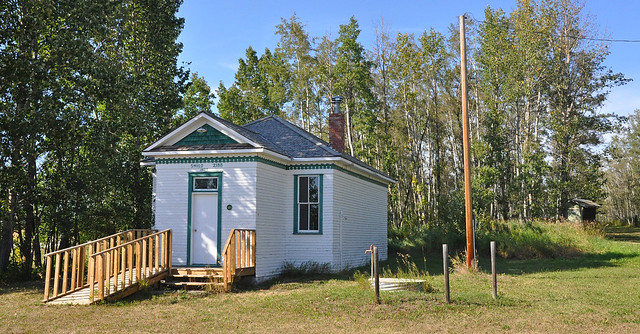
Fresh from our visit to the Caroline Wheels of Time Museum, we took a slight detour on our way home to visit Shilo School.

Shilo School

Depending on which source you believe, the school was built in either 1909 or 1910.  The year on the school itself is 1909 but the sign at the entrance to the property says 1910.  According to the Alberta Register of Historic Places, the Shilo School District No. 2188 borrowed $800 in 1910 for the construction and furnishing of the school.  Based on that information, I’m more inclined to believe it was built in 1910.

The building functioned as a school until 1952 when students began to be transported to nearby Caroline for classes.  As with many of these former schools, the building saw new life as a hub for community events.  Even today, the building sits adjacent to a well-maintained baseball diamond and the wheelchair ramp leading to the front door demonstrates it is not wanting for activity.

The door was locked so we couldn’t gain access to the inside, but peering in the windows reveals much of the interior detail remains and there is no mistaking that this was a school.

Outside, in addition to the aforementioned ball diamond, there is a solid-looking outhouse around the back and the water well, which the Shilo School District had to borrow an extra $400 for in 1911, remains near the front entrance.  The site is well protected by trees and the grounds are maintained.

I took the opportunity to put the drone up in the air and capture some footage of the school.

Sources:

Shilo School. (n.d.). Retrieved August 30, 2017, from https://hermis.alberta.ca/ARHP/Details.aspx?DeptID=1&ObjectID=4665-0754

Date of Visit:  August 26, 2017

Posted in drone, History | Tagged , , , , , , , , | Leave a comment

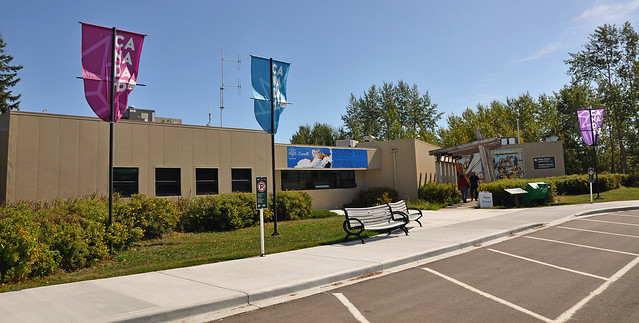
Rocky Mountain House National Historic Site

As I alluded to in my previous post, Emily and I went on a little road trip over the weekend.  This was our primary destination, but it ended up playing second fiddle to the Wheels of Time Museum.

DSC_5363

Visitor Centre at Rocky Mountain House National Historic Site

My personal history with Rocky Mountain House goes back many years.  When I was very young, good friends of my family moved from Coaldale to Rocky Mountain House and many of our summer vacations involved trips to visit them.  “Rocky” and the surrounding area always seemed a bit like a second home for us, and I remember visiting the Rocky Mountain House National Historic Site when I was very young, certainly in single digits in terms of years.  I’m sure if I knew where all the old family photo albums ended up, I could find a photo of me sitting in the York boat, circa 1980.

As an adult, it is great to see how little has changed here.  While I have no memories of the visitors’ centre, the rest of the place seems trapped in a time warp.  The small wooden kiosks still have the same “press a button and listen to a recording” setups that I remember from my first visits.  I’m sure the recording quality has been improved a lot in the 35+ years though.

My favorite items from my childhood remain.  In addition to the aforementioned York boat, the Red River cart is still here, as are the two chimneys which are the vast tangible remains of the trading post which once occupied this site.

Red River Cart and the chimneys from the fort

There were actually multiple posts built here between 1799 and 1875.  Both the North West Company and the Hudson Bay Company established trading posts here as the fur trade moved west into what would become Canada.  This area also served as a home base for David Thompson, the famed explorer and map maker.

I wouldn’t say there is plenty to do here, but the costumed interpretive staff were very friendly and willing to answer any questions we had, whether it was in regards to the fur trade or the blacksmithing demo taking place.  The trails are nicely maintained and allow for a pleasant walk along the banks of the North Saskatchewan River.

With it being Canada’s 150th birthday celebration, the fee for visiting the site was waived, which is a nice bonus.  A free history lesson and a good walk on a sunny day makes for a pretty decent outing in the late summer.

DSC_5370

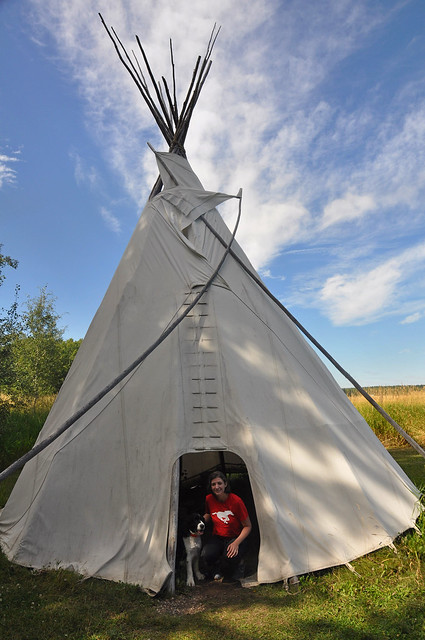
Tucker and Emily hanging out in a teepee

Posted in History, Travel | Tagged , , , , , | Leave a comment

Spending Time in Caroline

The door is open so we walk inside.  We see no one but someone has heard us come in.

“Hello?” we hear coming from the room to our right.  We head in that direction and walk into what was once a classroom but now serves as an exhibit room in the Caroline Wheels of Time Museum.

DSC_5388

The Wheels of Time Museum

At first glance we see no source of the voice and we’re wondering if we have disturbed the ghosts who may call this old school home.  While we may not see the ghosts, they have seen us.  “Hello,” the voice says one more time. Finally we look up.  There, perched on top of a step ladder, is not a ghost but a man.  Paintbrush in hand, he is putting some final touches on a mural which dominates one of the walls of the room we now find ourselves standing in. We ask about the price of admission and he responds with “Free.  Of course, if you want to put something in our donation bin we would really appreciate it since these places cost money to operate and maintain.” As he climbs down from the ladder, he introduces himself as John.  Not only is he a talented artist and semi-retired geologist, but he is going to be our host and tour guide as we take in all the Wheels of Time Museum has to offer.

DSC_5374

The Mural is Nearly Complete

We’ve driven by this museum in Caroline, AB many times as we have gone up and down Highway 22, a.k.a The Cowboy Trail.  Often tempted to stop, we’ve never managed to time it right — either the museum has been closed or we had someplace else we needed to be.  It happens all too often.  Today, however, our visit to the Rocky Mountain House National Historic Site took less time than expected so we’ve arrived at the Wheels of Time a couple of hours before closing.  That should give us plenty of time to check things our, right?

John proves immediately to be both a knowledgeable and personable host.  As we move from room to room and exhibit to exhibit he easily weaves between facts and stories, one anecdote leading to another.  Stopping to tell us where fact ends and legend begins since “Not everyone can tell, you know?” he reminds us.

After touring the old Caroline school, which now serves as the main museum building and office, we move to Big Bend School and teacherage, the former town office and fire hall, the trappers cabin, and a pioneer home.  Each building is outfitted in a manner befitting the finest of prairie museums.

DSC_5376

Big Bend School

DSC_5375

Inside Big Bend School

DSC_5386

Touring the Museum

1953 Fargo

1953 Fargo, Caroline’s first fire engine

With our tour complete, we return to the main building to purchase some ice cream.  John finds a bowl and dishes out some ice cream for Tucker the Dog, who eagerly digs in.  John has made a friend for life.

We carry on a discussion about other museums we have visited or want to visit, with John mentioning some of his other side projects.  Having lived in Caroline for more than 50 years, he is well acquainted with the history of the area.  Our love of one-room schoolhouses causes him to mention Shilo School which is not far away.  We’re sure to make a detour there on the way home.

While John is only completing his first summer of work at the museum, he has already had plenty of experiences dealing with the public.  He tells us of the different visitors he has had tour over the last few months and how each tour offers something unique.  He does it for the love of the history and it shows.  I highly encourage you to check out his work at Scrawny Johnny’s Paintings and Musings.

With only one week left in the season for the museum, we’re really glad we got a chance to stop here and meet John.  As we drive away, we know we’ve mentally added another item to our “hidden gem” list.  Who knew such a great stop would be waiting in small Caroline, Alberta?
Posted in History, Travel | Tagged , , , , , | 5 Comments

Alberta Prairie Railway

In my previous posting, I mentioned how Stettler is known for being the home of Alberta Prairie Railway Excursions.  We had noticed on their schedule that they were going to be running one of their steam engines on the day after CAMT and we thought it would be great fun to follow the train from Stettler to Big Valley and capture some images and drone footage along the way.

DSC_5303

Guests arrive at Stettler train station

Emily and I had the opportunity to ride with Alberta Prairie Railway Excursions (can I just call them APRE from now on?) a couple of years ago.  On that trip the train was powered by the 1958 General Motors diesel locomotive.  Today they would be running their 1920 Baldwin 2-8-0 Consolidation, badged as No. 41.

DSC_5318

No. 41 blowing off some steam

I won’t go into a detailed history of this old girl, but instead highly recommend you check out our friends at BigDoer.com and their article which goes into great detail about how it ended up in Stettler.

DSC_5321 DSC_5326

DSC_5331

We had no problem keeping up with No. 41 all along its trip into Big Valley.  We followed the gravel road between the towns, which offered us plenty of level crossings to capture photos.

At the first crossing, several of the people on board noticed the drone up in the air.  By the second and third crossings, people were waving at us and giving us smiles of recognition — let’s face it, with a bright red pickup truck towing a 23′ fifth wheel RV, we were far from inconspicuous on this run.  No one came up to talk to us in Big Valley, however; I guess they were too busy checking out the town and eating their roast beef dinner.

This was a really fun outing for us and gave us another excuse to visit Big Valley, which is one of our favorite Alberta towns.  Check out the short video I made as a result of our train chasing.

Posted in drone, History, Travel | Tagged , , , , , , , , , , , , , , | 2 Comments