
If you search for “Ronalane” using Google Maps, you will find yourself looking at a dot in the middle of an empty prairie landscape. But, zoom out a bit. What do you see? Large tracts of undeveloped land, set next to a picturesque s-curve in the Bow River. Seems like a place with a lot of potential, doesn’t it?
That is exactly what J.D. McGregor thought too. McGregor was a rancher who spent many days tracking down wandering cattle in this area. He felt that if there was a way to bring irrigation to this semi-arid land, the potential for growth was huge.
McGregor pitched the idea to some wealthy financiers in Britian and thus the Southern Alberta Land Company was created. The Company purchased 400,000 acres of land with the plan of bringing irrigation to the area. At the time, it was thought that it took 35 acres of grassland to raise one steer. With irrigation, the plan was to flip this ratio and instead raise 35 steer per acre.
McGregor became the managing director of the company and Ronald Lane was brought in as President. With the framework in place, they hired Arthur Grace as chief engineer who was tasked with conducting the survey of the land.
Grace determined the best place to intake water for the project was by Johnson Island near Carseland, Alberta. A combination of earthen and concrete dam was constructed to raise the water level the 12 feet it was determined would be needed. This would be the start of the project which became known as the “Big Ditch”.
Along the way, more engineering challenges awaited the team. The geography necessitated “the big cut”, which was a 64 foot deep, 1.75 mile long excavation to carry water through the natural barrier presented by the banks of the Bow River. This required the removal of 1,500,000 cubic yards of earth.
The Company also constructed two additional dams in the Snake Valley, which would eventually bring about the creation of Lake McGregor. This reservoir remains a much-loved recreational site for southern Albertans to this day, in addition to its primary irrigation function.
These were remarkable achievements considering this was the era of steam shovels. The Company had to import mules from St. Louis, MO because there were not enough horses in the area. While the Dominion Land Survey had outlined a series of road allowances back in the 1870s, no roads had yet been constructed. The Company was contractually obligated to build and maintain a bridge every place their canal crossed a road allowance. Approximately 80 such bridges were built.
We eventually get to the area around Ronalane. To get the canal from the west side of the Bow to the east, the Company planned to build a gigantic siphon. The siphon would be carried by a new bridge which would also be designed to carry vehicular traffic. Five spans set on concrete piers were required. The Company also planned on a railway running through the area from Suffield all the way to Lethbridge, a portion of which ended up being built by the Canadian Pacific Railway.
The Company laid out plans for several towns along the rail route, the crown jewel being Ronalane, named for the President of the Southern Alberta Land Company. They felt they could use the energy of the water in the siphon to generate electricity for the town. Thanks to large deposits of natural gas, they also planned on delivering gas to each home, along with a sewer system. This was very advanced stuff back in 1912! They even planned on eventually running an inter-city electric railway across the Ronalane Bridge.
However, it was not to be. Traversing approximately 119 miles meant there was a lot of water loss due to evaporation and seepage. The outbreak of World War One also stalled the project. Massive drought meant many farmers in the area were forced to surrender their lands. The project stalled and was eventually abandoned by 1914.
Eventually the assets of the Southern Alberta Land Company were acquired by the Canadian government. Some of the project’s work still remains in place, such as Lake McGregor mentioned above. Also remaining intact is the Ronalane Bridge.

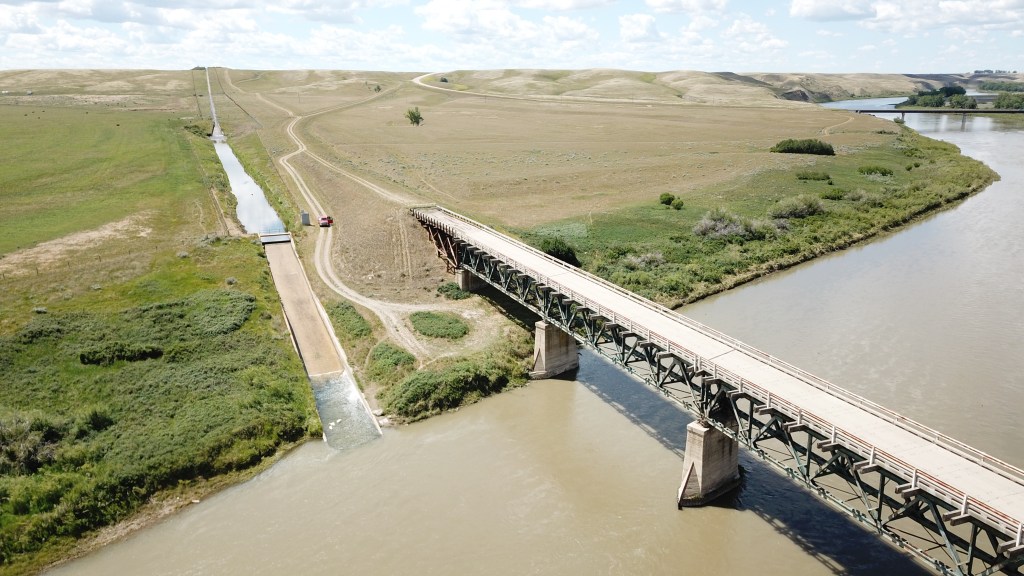
The bridge never did carry the siphon across the Bow. To the east of the bridge you can still see the concrete cradles which had been constructed to support the siphon. You can also see where the canal was dug for many miles, extending off to the horizon. However, the canal was never constructed east of the Bow at Ronalane. The canal has been sitting there dry for over one hundred years now. Discussions took place for many decades afterwards about whether or not to complete the project, but nothing ever happened. The planned towns, including Ronalane, remain just unincorporated place names on the map, although you can see the railbed still on the satellite images.


As for the Ronalane Bridge, it was apparently damaged in the 1950s and required massive reconstruction. It remained in use for several decades until Highway 524 was eventually realigned and new bridge was constucted further upstream on the Bow. Today the old Ronalane bridge still spans the Bow River, but it is blockaded at both ends and the wooden approaches are rotting away.


If you want to see the video I made of our trip to the Ronalane Bridge, you can click below:
Sources
•Alberta Register of Historic Places. (n.d.). In Alberta Register of Historic Places.
•Calgary Herald. (1912, September 17). Calgary Herald – Tuesday, September 17, 1912.
•Gershaw, F. W. (2018, January 18). History: Railways and irrigation. Canadian Cattlemen.
•Hanlon, P. (2019). MCGREGOR, JAMES DUNCAN. In Dictionary of Canadian Biography, 16. University of Toronto/Université Laval. https://www.biographi.ca/en/bio/mcgregor_james_duncan_16E.html
•Hind, E. C. (1912, September). The Big Ditch: Presented on the Occasion of the Opening of the Irrigated Tract of the Southern Alberta Land Company, Limited. https://ia802901.us.archive.org/35/items/P003740/P003740_text.pdf
•HistoricBridges.org. (2015, May 30). Old Ronalane Bridge.
•Medicine Hat Chamber of Commerce. (1938, February). Submissions of the Medicine Hat Chamber of Commerce respecting the proposed irrigation of the Redcliff-Ronalane District. http://www.demofarm.ca/water_haulers/pdf/history/History%20P.pdf
•Newspapers.com. (n.d.). Calgary_Herald_2001_08_10_28.pdf. Retrieved from https://www.newspapers.com/image/486268306/
•Prairie Land and Water Resources. (n.d.). Bow River Project. [Archived web content message].
•Swihart, R. (1975, January 29). Redcliff-Ronalane irrigation issue divides producers. The Lethbridge Herald.
•Wikipedia contributors. (n.d.). Ronald Lane. In Wikipedia, The Free Encyclopedia. Retrieved [Current Date of Response], from https://en.wikipedia.org/w/index.php?title=Ronald_Lane&oldid=1240059757
•Wikipedia contributors. (n.d.). Suffield, Alberta. In Wikipedia, The Free Encyclopedia. Retrieved [Current Date of Response], from https://en.wikipedia.org/w/index.php?title=Suffield,_Alberta&oldid=1174758407


 DanOCan