Two Endangered Elevators

It may be snowy and blustery today, but back in September when we made our way out to Moose Jaw for Threshing Bee, it was a glorious hot day.  While normal people would take the TransCanada Highway from Calgary to Moose Jaw, we opted for a slightly more creative route through Fox Valley, Saskatchewan.

The word in some of the grain elevator groups was that the grain elevators in Fox Valley, Mortlach, and Indian Head were scheduled for demolition over the next few months.  The first two on that list would be fairly easy to visit on this weekend run, but Indian Head would not be.

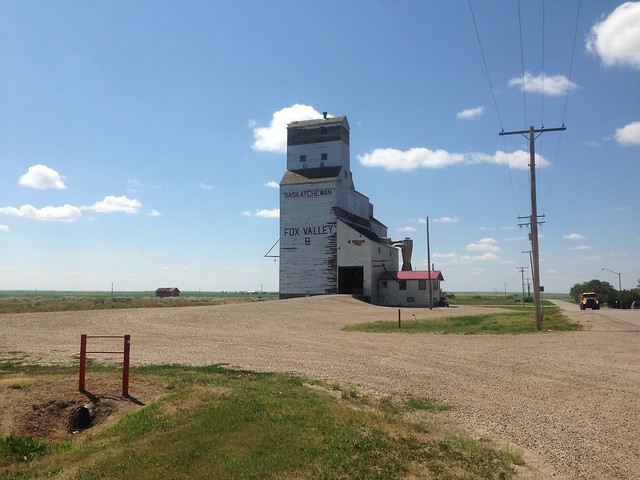
We had last visited Fox Valley back in July of 2015.  We were pleased to see both the Paterson (the one slated for demolition) and “Fox Valley B” were both still in place.

Fox Valley B

“Fox Valley B” in 2015 — not currently under threat of demolition

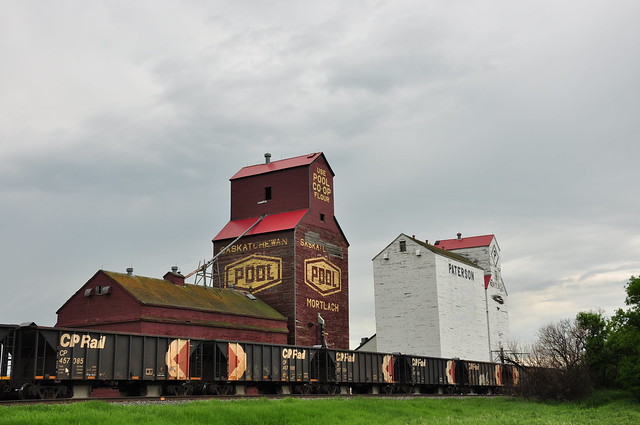
Mortlach, on the other hand, hasn’t been quite so lucky.  One of my favorite prairie towns, my first visits to Mortlach came in an era when it had two elevators.  Unfortunately, the picturesque Saskatchewan Wheat Pool elevator was demolished in 2011, leaving just one prairie giant left in this little town.

Mortlach, Saskatchewan

June 2009 – The Pool elevator on the left was demolished in 2011 and the Paterson on the right is scheduled to fall soon

After grabbing some drone footage of the remaining elevators in Fox Valley and Mortlach, we bid adieu to them knowing we would likely not see them again — except in old photos.

Check out the footage below:

Posted in drone, History, Travel | Tagged , , , , , , , | Leave a comment

Threshing Bee 2017

I think after five years I can officially call it a tradition.  Each year, on the weekend after Labour Day, I make the trip to Saskatchewan to attend the Threshing Bee at the Sukanen Ship Pioneer Village and Museum just south of Moose Jaw.  I call it the unofficial end to my summer.
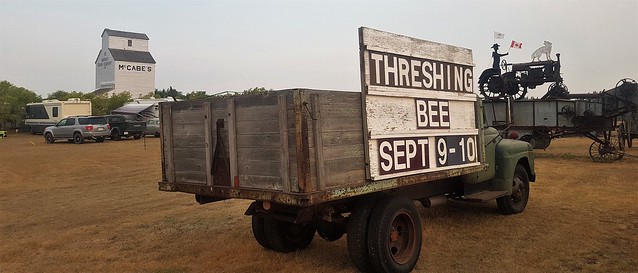
20170910_075656

The tradition has grown and changed over those five years.  For the first four years, the tradition involved tenting at Besant Campground near Mortlach.  Besant is one of my favorite campgrounds, having first opened in 1963 as part of the TransCanada Highway project.  It remains a delightful throwback but we decided to park our trailer on the museum grounds this year and save some commuting time.

Another change has been in the company I keep.  My first three years I made the trip with only Tucker the Dog in tow because Emily was still living stateside.  Now with that immigration process a distant memory, she has joined me the last two years.

My role has changed over the last five years as well.  My first year I was a regular attendee, in the second year I was recruited to drive Dean Redman’s 1953 Bickle-Seagrave in the parade, and that has now evolved into being a full-fledged volunteer and working as part of the safety crew, patrolling the grounds and keeping the public far enough away from the threshing and other live demos.


“The Sukanen”, as it is often called, has had the Threshing Bee tradition much longer.  It can be traced back to the very first year the museum opened in 1969.  What started as a single building where the local car enthusiasts displayed their collections has since grown into a full-fledged village with many buildings moved in from neighboring towns where they are preserved and opened up with displays.

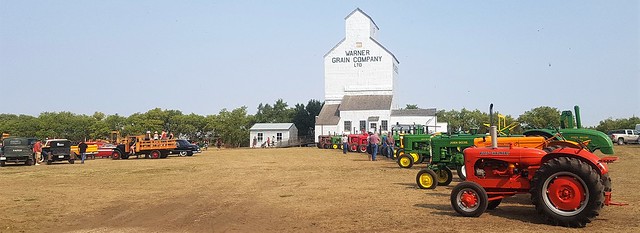
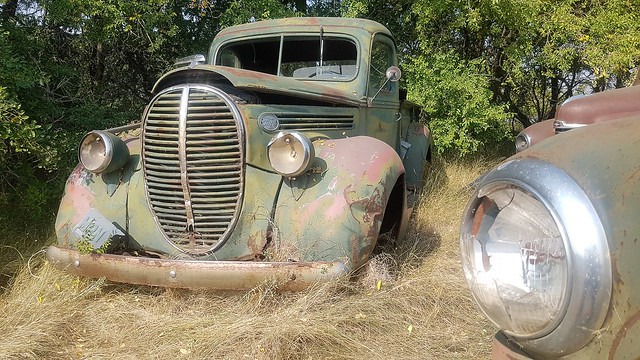
When it comes to vehicles, the museum is an eclectic mix of tractors, cars, trucks, fire apparatus, and farm implements — all in various states ranging from derelict to completely restored.  That crazy mix is what keeps us coming back because every time we visit we find something we hadn’t seen before.


Each morning at 08:00, the day kicks off with a pancake breakfast.  The display buildings open at 09:00 and things really get rolling from there.

This year’s schedule of events was a little different because the parade was broken into two sections, the tractors in the morning and the other vehicles in the afternoon.  This was a welcome change as many times there were too many vehicles and not enough drivers so people would have to complete the parade, jump off one tractor and then on to another and then go through the parade again.  As well, with so many vehicles the parade would often take a long time to complete and by breaking it up it makes it easier to sit through.

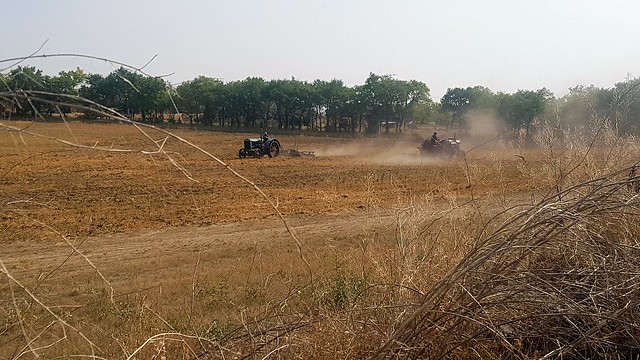
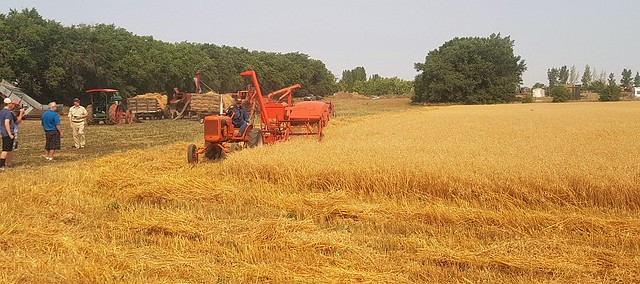
In addition to the two parades, each day features field demonstrations where the old machinery is actually put to work and is used to harvest the crop.  Once the crop has been cut, the threshing demos take place.  And, the last big event of the day is the antique tractor pull where the owners get the chance to have some fun and see how far they can pull the 8000lb sled.
20170910_080128

Throughout the day other activities are taking place.  You can catch the “people mover” and be pulled around on a horse-drawn wagon.  There are blacksmithing and rope making demonstrations taking place all day.  A new addition this year was the carnival area where three vintage thrill rides were brought in for the kids — well, they say for the kids but there were plenty of adults waiting to take their turns too.
20170910_104821

This field was plowed during the 2016 field demonstrations.  This year it was being disked as part of an ongoing demo of how prairie grassland was converted to farmland.
  

20170909_114209

Cutting the crop

20170909_135002

A threshing demo

I often call Threshing Bee weekend “DanOCan’s Christmas” because I look forward to it so much.  We try and vary the route out a bit every year so we get to visit some different towns along the way, and it gives us a chance to catch up with many of our Saskatchewan friends we don’t get to see very often.

It’s a perfect end to the summer season.

Posted in Events, History, Travel | Tagged , , , , , , , | 2 Comments

Ogilvie Wooden Grain Elevator Society

As many of you know, I have been involved with the Ogilvie Wooden Grain Elevator Society (OWGES) since it was fairly new. The Society’s mission is to preserve and protect the last wooden Ogilvie grain elevator in the province of Alberta. It stands today, as it has for nearly 100 years, in the village of Wrentham, Alberta.

“The Ogilvie” as we lovingly call it, was originally built in 1925. A balloon annex was added in 1951. Sold to the Alberta Wheat Pool in 1960 and then into private hands in 1968, it has been owned by OWGES since December of 2014.

As you would expect, there are mountains of paperwork involved in operating a society of this nature and it has not been an easy journey. The economic climate we have been operating in for the last few years has not been conducive for raising funds to even preserve the elevator, nevermind actually undertake any restoration work.

I think everyone who serves on the Society’s board understands this is going to be a marathon and not a sprint. We’re still in the early stages of this race and we just need to keep a steady pace and moving towards the end goal.

I put together some drone footage of the Ogilvie while on a trip down south last month. There I met our President and founding member Jason Sailer at the elevator.  Check it out and then also check out a video Jonathon Koch did when he visited the elevator in 2016.

Visit the Society’s site at facebook.com/OWGES for more information. You can also follow us on Twitter or email us at owges@yahoo.com.

Posted in drone, History | Tagged , , , , , , , , , , | 1 Comment

Shilo School

Fresh from our visit to the Caroline Wheels of Time Museum, we took a slight detour on our way home to visit Shilo School.

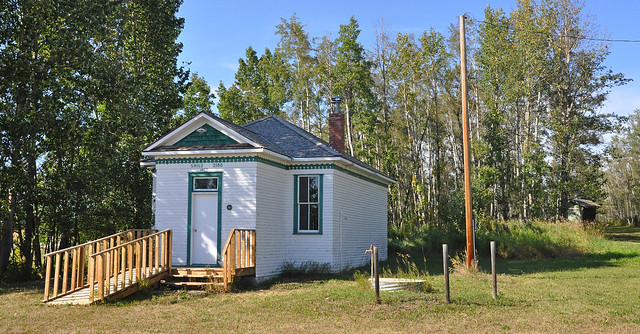
Shilo School

Depending on which source you believe, the school was built in either 1909 or 1910.  The year on the school itself is 1909 but the sign at the entrance to the property says 1910.  According to the Alberta Register of Historic Places, the Shilo School District No. 2188 borrowed $800 in 1910 for the construction and furnishing of the school.  Based on that information, I’m more inclined to believe it was built in 1910.

The building functioned as a school until 1952 when students began to be transported to nearby Caroline for classes.  As with many of these former schools, the building saw new life as a hub for community events.  Even today, the building sits adjacent to a well-maintained baseball diamond and the wheelchair ramp leading to the front door demonstrates it is not wanting for activity.

The door was locked so we couldn’t gain access to the inside, but peering in the windows reveals much of the interior detail remains and there is no mistaking that this was a school.

Outside, in addition to the aforementioned ball diamond, there is a solid-looking outhouse around the back and the water well, which the Shilo School District had to borrow an extra $400 for in 1911, remains near the front entrance.  The site is well protected by trees and the grounds are maintained.

I took the opportunity to put the drone up in the air and capture some footage of the school.

Sources:

Shilo School. (n.d.). Retrieved August 30, 2017, from https://hermis.alberta.ca/ARHP/Details.aspx?DeptID=1&ObjectID=4665-0754

Date of Visit:  August 26, 2017

Posted in drone, History | Tagged , , , , , , , , | Leave a comment

Rocky Mountain House National Historic Site

As I alluded to in my previous post, Emily and I went on a little road trip over the weekend.  This was our primary destination, but it ended up playing second fiddle to the Wheels of Time Museum.

DSC_5363

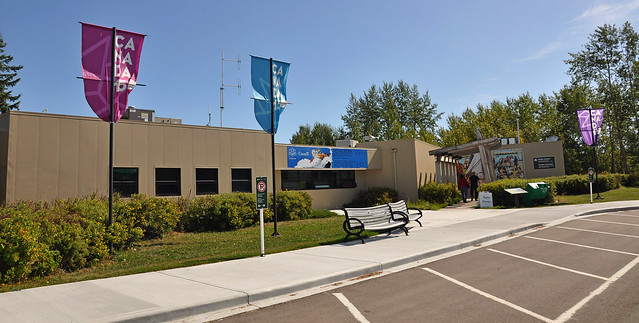
Visitor Centre at Rocky Mountain House National Historic Site

My personal history with Rocky Mountain House goes back many years.  When I was very young, good friends of my family moved from Coaldale to Rocky Mountain House and many of our summer vacations involved trips to visit them.  “Rocky” and the surrounding area always seemed a bit like a second home for us, and I remember visiting the Rocky Mountain House National Historic Site when I was very young, certainly in single digits in terms of years.  I’m sure if I knew where all the old family photo albums ended up, I could find a photo of me sitting in the York boat, circa 1980.

As an adult, it is great to see how little has changed here.  While I have no memories of the visitors’ centre, the rest of the place seems trapped in a time warp.  The small wooden kiosks still have the same “press a button and listen to a recording” setups that I remember from my first visits.  I’m sure the recording quality has been improved a lot in the 35+ years though.

My favorite items from my childhood remain.  In addition to the aforementioned York boat, the Red River cart is still here, as are the two chimneys which are the vast tangible remains of the trading post which once occupied this site.

Red River Cart and the chimneys from the fort

There were actually multiple posts built here between 1799 and 1875.  Both the North West Company and the Hudson Bay Company established trading posts here as the fur trade moved west into what would become Canada.  This area also served as a home base for David Thompson, the famed explorer and map maker.

I wouldn’t say there is plenty to do here, but the costumed interpretive staff were very friendly and willing to answer any questions we had, whether it was in regards to the fur trade or the blacksmithing demo taking place.  The trails are nicely maintained and allow for a pleasant walk along the banks of the North Saskatchewan River.

With it being Canada’s 150th birthday celebration, the fee for visiting the site was waived, which is a nice bonus.  A free history lesson and a good walk on a sunny day makes for a pretty decent outing in the late summer.

DSC_5370

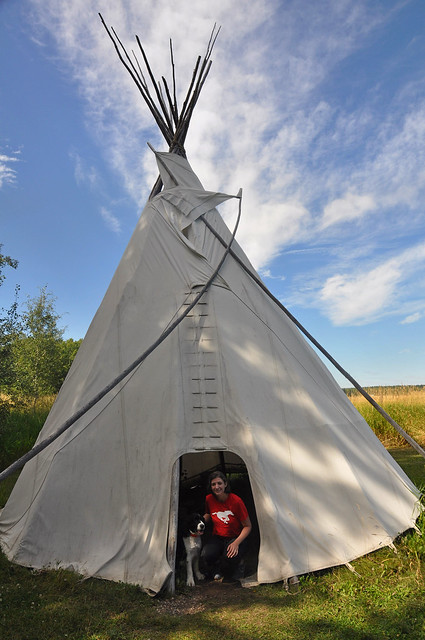
Tucker and Emily hanging out in a teepee

Posted in History, Travel | Tagged , , , , , | Leave a comment