A Brief History of the Big Ditch and Ronalane Bridge in Southern Alberta

If you search for “Ronalane” using Google Maps, you will find yourself looking at a dot in the middle of an empty prairie landscape. But, zoom out a bit. What do you see? Large tracts of undeveloped land, set next to a picturesque s-curve in the Bow River. Seems like a place with a lot of potential, doesn’t it?

That is exactly what J.D. McGregor thought too. McGregor was a rancher who spent many days tracking down wandering cattle in this area. He felt that if there was a way to bring irrigation to this semi-arid land, the potential for growth was huge.

McGregor pitched the idea to some wealthy financiers in Britian and thus the Southern Alberta Land Company was created. The Company purchased 400,000 acres of land with the plan of bringing irrigation to the area. At the time, it was thought that it took 35 acres of grassland to raise one steer. With irrigation, the plan was to flip this ratio and instead raise 35 steer per acre.

McGregor became the managing director of the company and Ronald Lane was brought in as President. With the framework in place, they hired Arthur Grace as chief engineer who was tasked with conducting the survey of the land.

Grace determined the best place to intake water for the project was by Johnson Island near Carseland, Alberta. A combination of earthen and concrete dam was constructed to raise the water level the 12 feet it was determined would be needed. This would be the start of the project which became known as the “Big Ditch”.

Along the way, more engineering challenges awaited the team. The geography necessitated “the big cut”, which was a 64 foot deep, 1.75 mile long excavation to carry water through the natural barrier presented by the banks of the Bow River. This required the removal of 1,500,000 cubic yards of earth.

The Company also constructed two additional dams in the Snake Valley, which would eventually bring about the creation of Lake McGregor. This reservoir remains a much-loved recreational site for southern Albertans to this day, in addition to its primary irrigation function.

These were remarkable achievements considering this was the era of steam shovels. The Company had to import mules from St. Louis, MO because there were not enough horses in the area. While the Dominion Land Survey had outlined a series of road allowances back in the 1870s, no roads had yet been constructed. The Company was contractually obligated to build and maintain a bridge every place their canal crossed a road allowance. Approximately 80 such bridges were built.

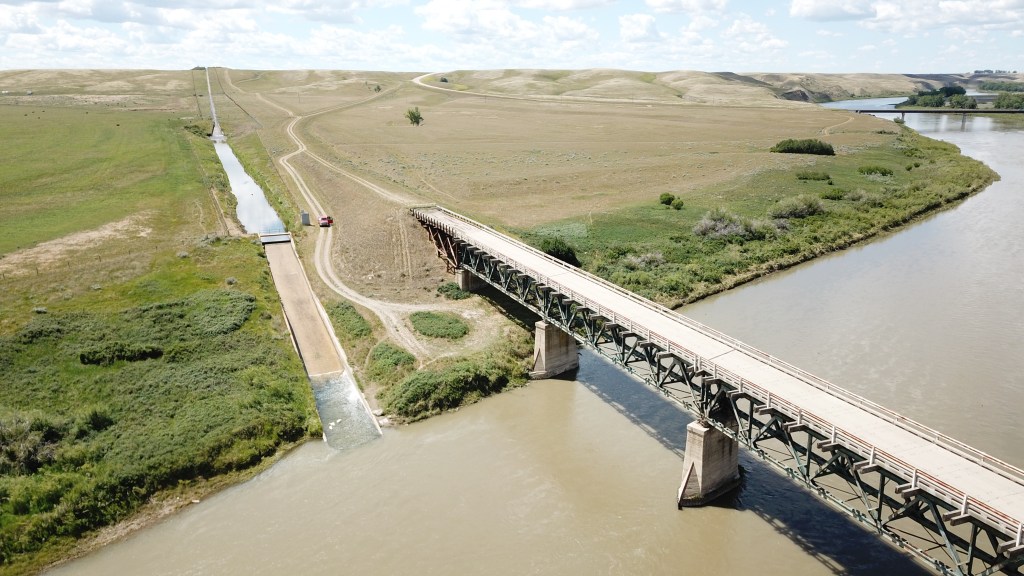
We eventually get to the area around Ronalane. To get the canal from the west side of the Bow to the east, the Company planned to build a gigantic siphon. The siphon would be carried by a new bridge which would also be designed to carry vehicular traffic. Five spans set on concrete piers were required. The Company also planned on a railway running through the area from Suffield all the way to Lethbridge, a portion of which ended up being built by the Canadian Pacific Railway.

The Company laid out plans for several towns along the rail route, the crown jewel being Ronalane, named for the President of the Southern Alberta Land Company. They felt they could use the energy of the water in the siphon to generate electricity for the town. Thanks to large deposits of natural gas, they also planned on delivering gas to each home, along with a sewer system. This was very advanced stuff back in 1912! They even planned on eventually running an inter-city electric railway across the Ronalane Bridge.

However, it was not to be. Traversing approximately 119 miles meant there was a lot of water loss due to evaporation and seepage. The outbreak of World War One also stalled the project. Massive drought meant many farmers in the area were forced to surrender their lands. The project stalled and was eventually abandoned by 1914.

Eventually the assets of the Southern Alberta Land Company were acquired by the Canadian government. Some of the project’s work still remains in place, such as Lake McGregor mentioned above. Also remaining intact is the Ronalane Bridge.

The old Ronalane Bridge – June 29, 2025

The bridge never did carry the siphon across the Bow. To the east of the bridge you can still see the concrete cradles which had been constructed to support the siphon. You can also see where the canal was dug for many miles, extending off to the horizon. However, the canal was never constructed east of the Bow at Ronalane. The canal has been sitting there dry for over one hundred years now. Discussions took place for many decades afterwards about whether or not to complete the project, but nothing ever happened. The planned towns, including Ronalane, remain just unincorporated place names on the map, although you can see the railbed still on the satellite images.

The canal which was constructed but never used is still visible on the east side of the bridge.
The concrete cradles still sit waiting to support the siphon which was never constructed.

As for the Ronalane Bridge, it was apparently damaged in the 1950s and required massive reconstruction. It remained in use for several decades until Highway 524 was eventually realigned and new bridge was constucted further upstream on the Bow. Today the old Ronalane bridge still spans the Bow River, but it is blockaded at both ends and the wooden approaches are rotting away.

The west approach to the Ronalane Bridge is blocked off.
The wooden approaches are showing significant signs of decay. Venturing out onto the bridge is not advised (and very likely illegal too!)
The realigned highway and new bridge are visible at the top of this photo.

If you want to see the video I made of our trip to the Ronalane Bridge, you can click below:

Sources

•Alberta Register of Historic Places. (n.d.). In Alberta Register of Historic Places.

•Calgary Herald. (1912, September 17). Calgary Herald – Tuesday, September 17, 1912.

•Gershaw, F. W. (2018, January 18). History: Railways and irrigation. Canadian Cattlemen.

•Hanlon, P. (2019). MCGREGOR, JAMES DUNCAN. In Dictionary of Canadian Biography, 16. University of Toronto/Université Laval. https://www.biographi.ca/en/bio/mcgregor_james_duncan_16E.html

•Hind, E. C. (1912, September). The Big Ditch: Presented on the Occasion of the Opening of the Irrigated Tract of the Southern Alberta Land Company, Limited. https://ia802901.us.archive.org/35/items/P003740/P003740_text.pdf

•HistoricBridges.org. (2015, May 30). Old Ronalane Bridge.

•Medicine Hat Chamber of Commerce. (1938, February). Submissions of the Medicine Hat Chamber of Commerce respecting the proposed irrigation of the Redcliff-Ronalane District. http://www.demofarm.ca/water_haulers/pdf/history/History%20P.pdf

•Newspapers.com. (n.d.). Calgary_Herald_2001_08_10_28.pdf. Retrieved from https://www.newspapers.com/image/486268306/

•Prairie Land and Water Resources. (n.d.). Bow River Project. [Archived web content message].

•Swihart, R. (1975, January 29). Redcliff-Ronalane irrigation issue divides producers. The Lethbridge Herald.

•Wikipedia contributors. (n.d.). Ronald Lane. In Wikipedia, The Free Encyclopedia. Retrieved [Current Date of Response], from https://en.wikipedia.org/w/index.php?title=Ronald_Lane&oldid=1240059757

•Wikipedia contributors. (n.d.). Suffield, Alberta. In Wikipedia, The Free Encyclopedia. Retrieved [Current Date of Response], from https://en.wikipedia.org/w/index.php?title=Suffield,_Alberta&oldid=1174758407

Posted in Uncategorized | Tagged , , , , , , , , , | Leave a comment

Restoring Alberta’s Prairie Sentinel: The Dorothy Grain Elevator Rises Again

In the world of historic grain elevators, good news is rare. If an elevator makes the news, it usually means it was either destroyed by fire or demolished. But today, we bring you a success story: the iconic grain elevator in Dorothy, Alberta is being restored.

Built in 1928 by the Alberta Pacific Grain Company, most sources agree the elevator remained in use until 1951. Since then, it has sat deteriorating. A windstorm in the summer of 2015 ripped the roof off the cupola, and it looked like that might be the final straw for this prairie sentinel.

Grain elevator at Dorothy, Alberta (July 2, 2017)
Drone photo showing inside of 1928 Alberta Pacific Grain Company elevator (May 30, 2020)

However, against all odds, funding was secured and restoration work began in April of this year. Since then, the structure has been stabilized, a new roof added, missing panels replaced using parts from a donor elevator in Saskatchewan, and a fresh coat of paint was being applied at the time of our visit.

After appearing in advertisements, Tom Cochrane’s music video for Life is a Highway, and even a cameo in Ghostbusters: Afterlife, the Dorothy grain elevator has been brought back from the brink—and is set to stand tall against the prairie sky for years to come.

Sources:

Special Areas Board. (2025, April). Repairs underway at Dorothy Elevator. https://specialareas.ab.ca/2025/04/repairs-dorothy-elevator/

Calgary CityNews Staff. (2025, June 1). Alberta grain elevator restoration underway. CityNews. https://calgary.citynews.ca/2025/06/01/alberta-grain-elevator-restoration-underway/


Drumheller Online Staff. (2025, April 14). Revival of Dorothy elevator. DrumhellerOnline. https://www.drumhelleronline.com/2025/04/14/revival-of-dorothy-elevator/

Posted in Uncategorized | Tagged , , , , , , , , , , , , , , , , | Leave a comment

Sharples: An Extremely Endangered Grain Elevator

It’s never a good thing to learn another grain elevator is on the endangered list. It is especially bad when that elevator is one of the most-photographed elevators in the entire province of Alberta. Not only is the 1923 elevator at Sharples, Alberta a registered historic resource, but the entire site is listed of the Alberta Register of Historic Places.

Sharples does not appear to have ever amounted to much as a settlement. It seems everything you can find online about it all use the same single source, the aforementioned Alberta Register of Historic Places. I’ll summarize it here and then link to the entire article at the bottom.

In 1923, the Canadian Pacific Railway built a spur line from Drumheller through to the town of Carbon. The line ran through the Knee Hills Creek Valley and was primarily used for hauling coal and grain. The Parrish and Heinbecker company built an elevator at Sharples in that same year. Later, in 1927, the Alberta Pacific Grain Company would add a second elevator. The second elevator would eventually be taken over by the Alberta Wheat Pool. When the CPR abandoned the spur line in 1982, the tracks were removed and the Wheat Pool elevator was demolished.

The remains of the storage building lie in ruins in front of the P&H grain elevator in Sharples, Alberta. October 21, 2006

I first visited the Sharples elevator in October of 2006. At that time there were remains of a building to the south of the elevator office. I believe these were the remains of the outhouse/storage mentioned in the listing on Alberta Register.

This would be the first of many visits I would make to the elevator over the next 19 years. I have visited Sharples in all seasons, all types of weather, and at all times of the day and night. Sharples was like an old friend you could always count on.

Sharples elevator and barn seen at night. January 29, 2010

It’s not just the elevator. On site you will also find a barn, which is believed to date to the same era as the elevator. It was built to refresh and house the horses which farmers used to haul wheat to the elevator. In that era, horse and wagon was the most common method of hauling grain. That is why grain companies built elevators approximately every six miles along the railway. This distance was how far a horse could reasonably pull a wagon full of grain. Sharples is unique in the province. It is the only site with an original railroad barn still on site, accompanied by a grain elevator.

The barn as it stood in 2006.
The barn as it stands in 2025.
In 2025 the barn is beginning to collapse.

So, why do I call this elevator “extremely” endangered? Apparently the elevator site was gifted to Alberta Trailnet for purposes of developing a recreational trail through the area. This is a great idea. The Knee Hills Creek Valley is very scenic and the road which runs through Sharples does not go the entire length of the valley, meaning large portions of the valley cannot be accessed by the public. A multi-purpose recreational trail running from Carbon to Drumheller would be a tremendous tourist draw.

Unfortunately, TrailNet does not have the mission — nor the funds — to preserve and/or restore a grain elevator. As such, my understanding is they have notified Kneehill County if someone is not found in the immediate future to take over the grain elevator, they will apply for the permits to begin demolition and cleanup of the site. This picturesque site which has been home to the P&H elevator for over one hundred years will no longer exist.

With that in mind, I put word out to friend Neil “Fotoman” Young that we were intended to visit the Sharples elevator for likely the last time. He agreed to meet us out there so we could fly our drones and document this location. You can see the adventure and get a peek inside the elevator and barn by watching our video here:

If you are a fan of historic grain elevators, I suggest you do not wait and get out to Sharples now and say your own goodbyes.

SOURCES:

Sharples Grain Elevator: https://hermis.alberta.ca/ARHP/Details.aspx?DeptID=2&ObjectID=HS+38505

Sharples Barn: https://hermis.alberta.ca/ARHP/Details.aspx?DeptID=2&ObjectID=HS+78723

Elevator Office: https://hermis.alberta.ca/ARHP/Details.aspx?DeptID=2&ObjectID=HS+78721

Annex: https://hermis.alberta.ca/ARHP/Details.aspx?DeptID=2&ObjectID=HS+78720

FRIENDS OF THE BLOG:

Fotoman’s YouTube Channel: https://www.youtube.com/@fotomancalgary

Posted in Uncategorized | Tagged , , , , , , , , , , | Leave a comment

Kicking Off Camping Season: Red Lodge, Gleniffer Lake & More

Spring is here, which means it’s time to bring Bella the Boler out of hibernation and hit the road!


Bringing Bella Back to Life
Every year, there’s something magical about that first camping trip of the season. This time, we took our 1978 Boler trailer west of Bowden, Alberta to Red Lodge Provincial Park, nestled along the shores of the Little Red Deer River.


Camping in Red Lodge Provincial Park
The land that Red Lodge Provincial Park has been a favorite place for Albertans to recreate since the 1920s. It officially became a provincial park in 1951 and offers a mix of riverfront sites, lush greenery, and peaceful ambiance. It was the perfect spot to ease into camping season, complete with campfire nights under the stars.

Bella the Boler in Site D77


Exploring Beyond the Campsite: Gleniffer Lake & Dickson Dam
Of course, we can’t sit still for long! We set out to explore Gleniffer Lake, a beautiful reservoir created by Dickson Dam, which plays a key role in water management across Alberta. Along the way, we learned more about the dam’s history and soaked up some breathtaking scenery.


Campfire Vibes & Looking Ahead
There’s nothing like ending a day of exploration with a roaring campfire, good conversation, and the soothing sounds of the river nearby. As our 2025 camping season gets underway, we’re excited for more road trips, adventures, and vintage camping memories!


Follow Along on Our Journey!
Want to see the trip in action? Check out our latest video:

Part 1
Part 2


Are there places we should explore next? Drop your suggestions in the comments! 🚐🔥

Posted in Boler, Travel | Tagged , , , , , , , , , , | Leave a comment

The Last Prairie Giant Falls – Saying Goodbye to Vulcan’s Grain Elevator

On a quiet April afternoon, I took a drive to Vulcan, Alberta, to witness a moment in history—the demolition of the town’s last remaining grain elevator. These towering landmarks, once an unmistakable symbol of the prairies, are disappearing at an alarming rate, leaving behind blank skylines where giants once stood.


For decades, Vulcan was known for its legendary “Nine in a Line”—a row of towering grain elevators that defined the town’s identity and served as a vital part of its agricultural past. But as time passed, their numbers dwindled, and now, the final one is being torn down. I felt compelled to document this bittersweet occasion, capturing the remnants before they vanish entirely.


Mabel and I hit the road, camera in hand, to preserve this moment. Watching the elevator’s annex be hauled away, I couldn’t help but reflect on what these structures meant to generations before us. They were more than just storage facilities—they were meeting points, economic drivers, and silent sentinels watching over the vast golden fields.


This video is my small way of ensuring that Vulcan’s last grain elevator—like all the others before it—is remembered.


📽 Watch the video here:

Video recorded April 26, 2025

These prairie landmarks may be disappearing, but their legacy lives on in the memories of those who knew them. Did you grow up near a grain elevator? Have you watched one fall, or seen one saved? I’d love to hear your thoughts and personal stories in the comments below. Let’s keep this conversation going and preserve the history together!

EDIT 2025.04.27 19:26: This post was originally published with the name “Nanton” instead of “Vulcan”. Whoops!

Posted in History | Tagged , , , , , , , , , , , , , , , , , , , , , | 2 Comments